
Free your teams from constant grind by resolving thousands of tasks with a single decision.
This is Decision-Based Exposure Management.
Triage | Prioritization | Ownership | Remediation
Your teams triage the same exposures again and again, while priorities are endlessly reshuffled instead of resolved.
“Who owns this?” debates delay action while
vulnerabilities remain unpatched.
Platforms create workflows and route tickets - but your team still does all the actual remediation work manually.


THE NEW PARADIGM
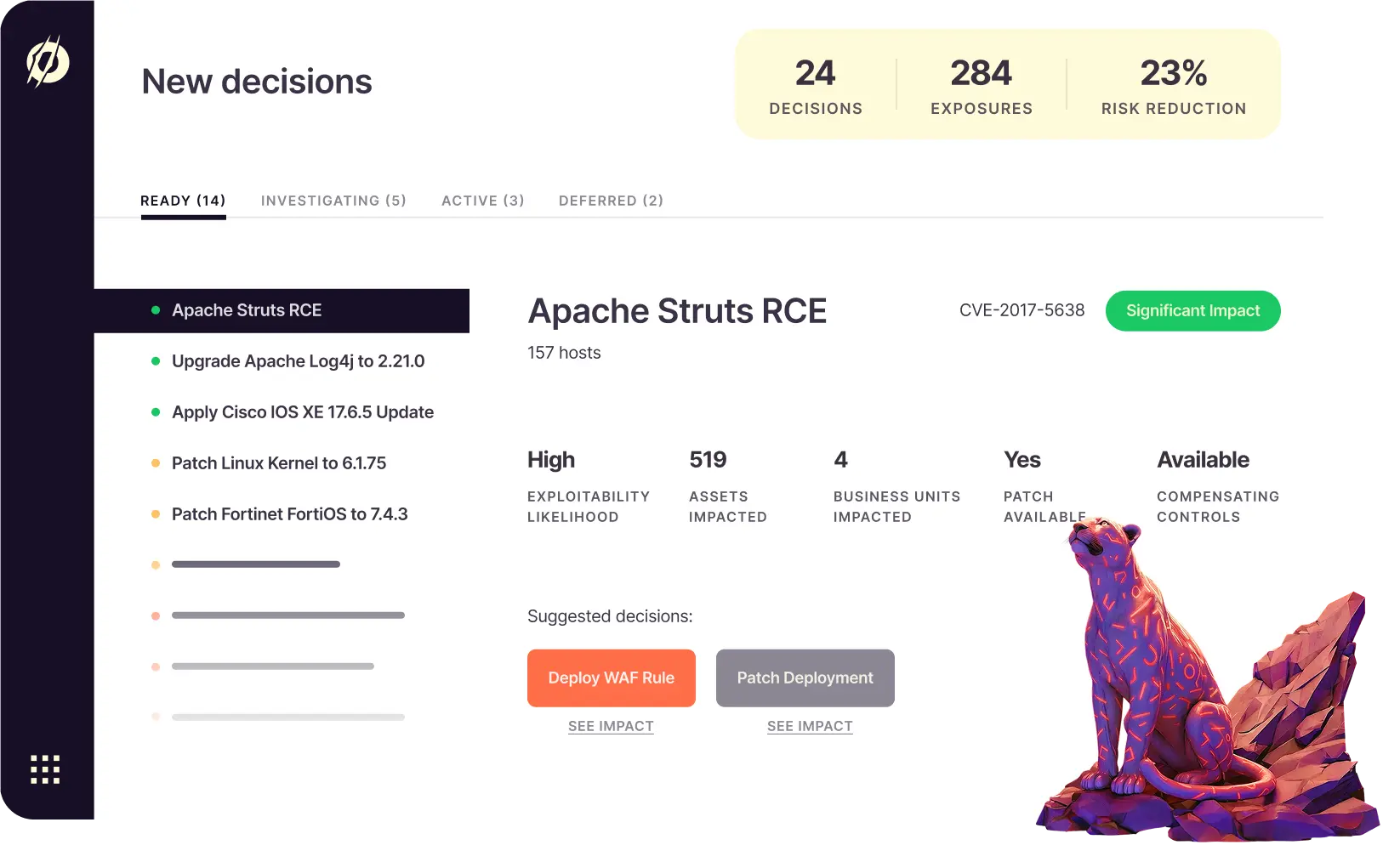
With Decision-Based Exposure Management, one single decision resolves
thousands of tasks - and our agents remember it, enforcing continuous resolution
across every similar exposure - now and in the future.
End the backlog by replacing assessment, prioritization, and resolution with an agentic-native process built on decisions.
Decisions persist as operating rules as reality changes.

No rip-and-replace required.

Exposures and tasks

Onit analyzes thousands of exposure cases across your org to pinpoint where human action is repeatedly required.

Decision surfacing
Onit collapses those repeated interventions into a small set of upstream human judgments to be made.

Decision fabric
Once made, those decisions are integrated across Onit’s entire agentic system as living operating rules.

Continuous resolution
When similar cases arise, those decisions spring into action to direct resolution, without humans ever needing to engage tasks again.


Small security teams operate at enterprise scale without adding headcount

From industry average of 63-270 days to hours of resolution

AI agents ensure all exposures addressed
It is truly going to be an AI versus AI war... having a solution that adapts to our environment, that helps us close in an automated fashion those vulnerabilities before the attackers have the ability to exploit those vulnerabilities is where organizations need to be.
Derek Hardy | CSO, Marvell


The promise of using a tool like this to automate a huge amount of manual work allows my team to focus on more important issues - it ensures they prioritize their time on more strategic efforts.
Chase Carpenter | CSO, Honeywell


Fifty percent of remediation tasks bounce back because ownership is wrong. Another thirty percent stall because no one knows the right fix path for that environment. I’ve lived this at every organization I’ve led. Onit is the first platform that eliminates both problems.
Oran Hollander | CSO, SAP Fioneer


The industry has become great at telling you what’s wrong, but nobody tells you how to fix it. We’ve seen the evolution from legacy scanners to Risk-Based Vulnerability Management and beyond, and remediation has always been where progress stalls. Onit Security changes that equation.
Gur Talpaz | GP, Brightmind & former SVP, CrowdStrike


For years, the hardest part wasn’t finding vulnerabilities - it was understanding their impact, assigning the right ownership, and actually getting them fixed. Onit connects the dots across tools, enriches findings with real context, and drives end-to-end remediation. It eliminates the manual churn and finally turns vulnerability management into measurable risk reduction.
Vishvander Singh | Sr. Manager, Cyber Security




Humans define judgment. Agents execute. Progress compounds - it never resets. Ready to end the backlog?
GET A DEMO