
Stop resolving exposures one at a time
Onit takes the flood of findings from your scanners, cuts what isn’t exploitable, and collapses the rest into a handful of decisions. The same exposure across a hundred servers becomes one call, not a hundred tickets. You decide once. Onit does the rest
Built as a system, not a feature layer
Onit runs as a six-layer agentic system. Each layer feeds the next, all sharing one context.

Data ingestion and noise reduction
Ingests findings from security tools, cloud, CMDBs, ticketing, and collaboration systems, then normalizes, deduplicates, and filters.
Mechanism: Correlates the same underlying finding across scanners that report it under different CVE mappings, asset names, and severities, collapsing them to one canonical exposure.
- In: scanners, CSPM, EDR/XDR, cloud, CMDB.
- Out: deduplicated canonical exposures
Mechanism: Correlates the same underlying finding across scanners that report it under different CVE mappings, asset names, and severities, collapsing them to one canonical exposure.
- In: scanners, CSPM, EDR/XDR, cloud, CMDB.
- Out: deduplicated canonical exposures

Contextual attackability
analysis
Validates whether each exposure is reachable and exploitable in your environment. Only real risk continues.
Mechanism: Cross-references network reachability, runtime and loaded status, and live exploit activity such as KEV and weaponization, so a critical-by-CVSS finding that isn’t actually exploitable drops down the queue.
- Signals: reachability, runtime status, KEV / exploit intel
Mechanism: Cross-references network reachability, runtime and loaded status, and live exploit activity such as KEV and weaponization, so a critical-by-CVSS finding that isn’t actually exploitable drops down the queue.
- Signals: reachability, runtime status, KEV / exploit intel

Organizational knowledge
graph
Maps ownership and business context from ticketing, repositories, CMDBs, messaging apps, and org charts into one graph.
Mechanism: Infers ownership from commit authorship, historical patterns, and service maps, not just static CMDB records, and re-resolves as teams reorg.
- Derives: owner, blast radius, business criticality
Mechanism: Infers ownership from commit authorship, historical patterns, and service maps, not just static CMDB records, and re-resolves as teams reorg.
- Derives: owner, blast radius, business criticality

Decision and reasoning
engine
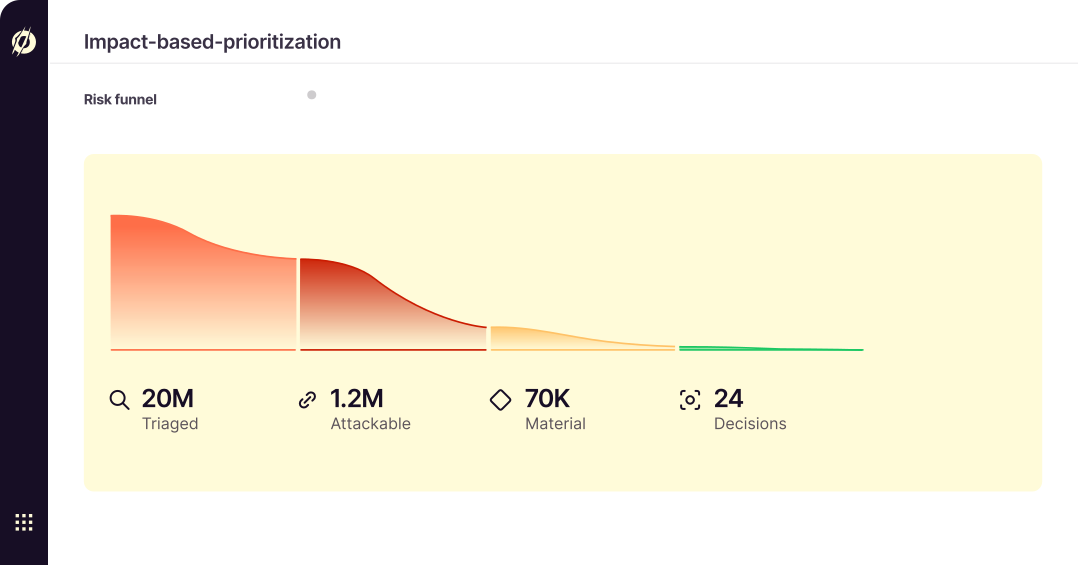
Reasons across the graph to group exposures that resolve together and rank each by real-world impact.
Mechanism: Each decision is codified as a reusable rule keyed to the exposure class and business context, so future matching findings resolve automatically without re-triage. This is what “decide once” means technically.
- Output: persistent decision + rationale
Mechanism: Each decision is codified as a reusable rule keyed to the exposure class and business context, so future matching findings resolve automatically without re-triage. This is what “decide once” means technically.
- Output: persistent decision + rationale

Specialized agents
The system is agentic end to end. Specialized agents own each job in the pipeline and share one context.
Mechanism: Discovery, ownership, exploitability, threat intel, prioritization, resolution, remediation, and mitigation each run as a dedicated agent, in parallel, sharing one context.
- Agents: Agents that run in parallel on one shared context
Mechanism: Discovery, ownership, exploitability, threat intel, prioritization, resolution, remediation, and mitigation each run as a dedicated agent, in parallel, sharing one context.
- Agents: Agents that run in parallel on one shared context

Human oversight
Your team validates ownership, approves actions, and calibrates future behavior.
Mechanism: Every agent action passes an approval gate, writes to an audit trail, and is reversible in one step, across both remediations and mitigations.
- Guarantee: nothing executes without approval
Mechanism: Every agent action passes an approval gate, writes to an audit trail, and is reversible in one step, across both remediations and mitigations.
- Guarantee: nothing executes without approval
Humans
define judgment.
Agents execute.
From fragmented findings to resolution, by decision
Six steps take an exposure from the moment it lands to the moment it’s closed and stays closed. Each maps to a layer of the platform.

Four capabilities.
One continuous system.
Each one closes a specific gap in the resolution lifecycle. Together, they leave none.
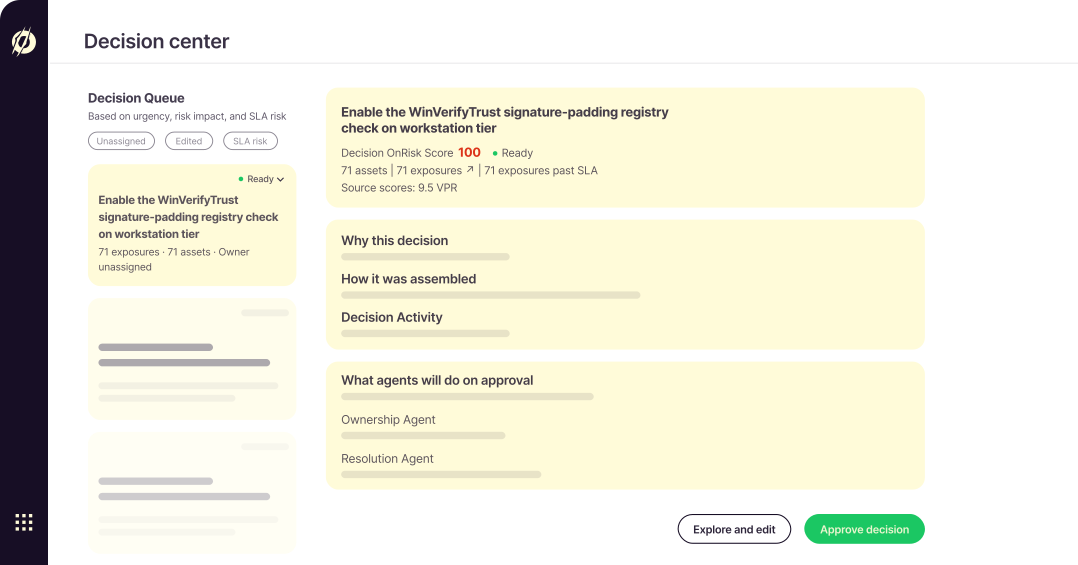
Your exposure program, running continuously. Findings become decisions, decisions stay current as your environment changes, and nothing sits in a backlog waiting to be re-triaged.
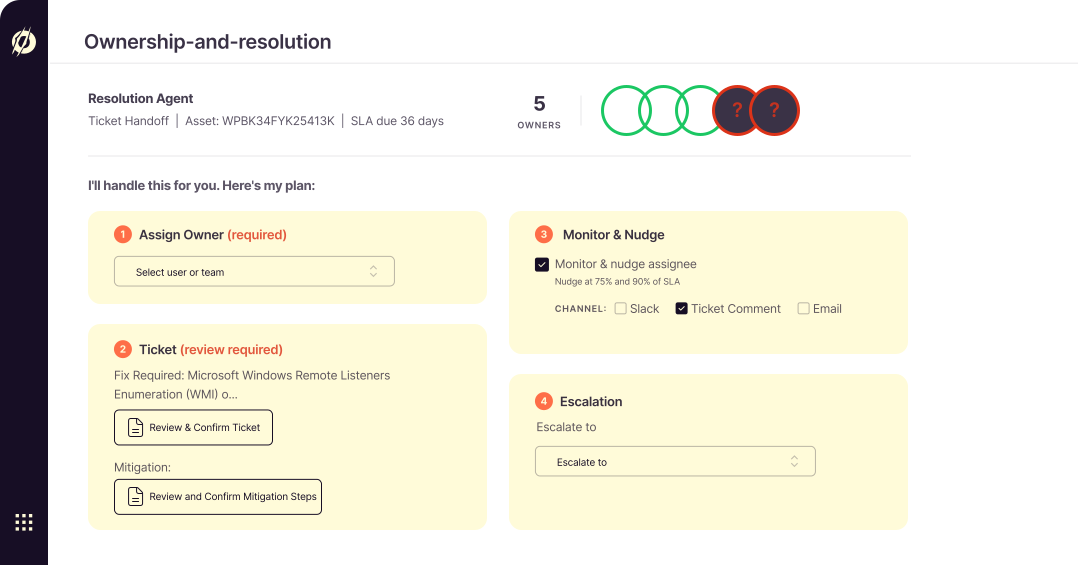
No more ownership guessing. Onit resolves who acts on each decision, then nudges, escalates, and tracks the work to closure, instead of opening a ticket and hoping. No bounce-back.
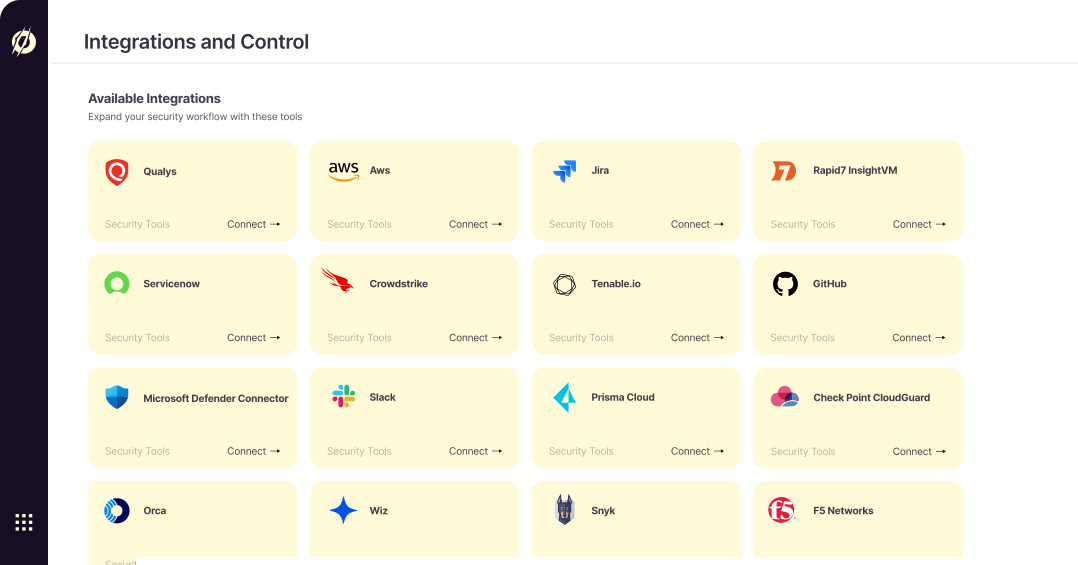
Connects to your existing stack. No agents, no sidecars, full audit trail.
What different looks like
Adversaries now exploit vulnerabilities before patches exist. Your remediation still takes months.
55 days to
2.7 hours
Time to resolve
42M findings to
36 decisions
Workload
A team of 20, ahead of 50 million exposures
Scale
Every action approved. Every decision audited.
Onit is not a black box. Nothing moves without a human decision. The human stays in the loop on every action that matters. Every decision is logged and can be reverted.
“As we continue to adopt the Onit platform, it takes less and less to manage vulnerability management, relying on the intelligence the platform brings to help us make decisions and execute them quickly.”

See what closing the backlog looks like
Decide once. Resolve forever.
Most exposure management tools give you a better view of the problem. Onit gives you a platform that solves it.